I've spent the past couple of mornings reading Raymond Chandler's The Long Goodbye, with fits of both pleasure and annoyance. Chandler has a distinct view of a certain type of American life, and the story is fairly absorbing. It's genre fiction, and I can't claim to see a whole lot of depth to it beyond what's there, so I must confess I'm a little baffled by all the blurbists who think of him as some kind of first-rate literary artist.
Detectives in hard-boiled fiction live in a kind of purgatory, I think: they live above the inferno of the damned and well below the paradise of the decadent wealthy, and on a moral scale they are leagues beyond either -- they, and Marlowe is fairly typical in this regard, tend to be somewhat smug observers of rottenness, which makes him a little tiresome as a narrator. Marlowe speaks in a know-it-all voice -- he wears his toughness on his sleeve and wisecracks overmuch, which is why the hard-boiled tone has always been so ripe for parody. Beneath that voice, though, you get a raw moral sense of the distance of American lives from each other -- that of Marlowe versus the writer Roger Wade, for example.
For those who haven't read the novel -- and I haven't yet finished it (although I've seen the Robert Altman film many times, so I have a hunch how it ends) -- it has a couple of plots running that eventually dovetail. One is that Marlowe meets a drunken prettyboy named Terry Lennox and helps him get out of town just after Lennox's rich slutty wife Sylvia turns up dead. Lennox -- whom Marlowe believes is innocent -- goes to Mexico, where he presumably kills himself out of guilt; case closed, as far as the cops are concerned, although not for Marlowe, who doesn't believe Lennox committed suicide and still pokes away at a case everyone wants to cover up. Marlowe then gets another job looking after a commercial writer, Roger Wade, an alcoholic who is unable to finish his latest novel, possibly because someone is blackmailing him. The Wades live right near the Lennoxes; Wade's wife is a real wacko and her doctor is Sylvia's brother-in-law, Wade had an affair with Sylvia, Wade winds up dead as well, and, well, that's about as far as I've read.
Anyway, there were an interesting couple of passages in this morning's reading that contrast Marlowe and Wade.
Marlowe talks about what a rotten town L.A. is, but that he chooses to live here, chooses not to pursue the American Dream of a house with five kids and a mortgage. That kind of life, he seems to say, is not only a dead end, but one which avoids life; for him, living means taking your chances visiting this glorious hellhole of despair -- with its adultery, whiskey (it runs freely), cigarettes, and casual deaths -- a place where he could never afford to be a permanent resident.
Roger, on the other hand, is a resident; he lives the good life by writing historical romances about a world which he knows never existed: a fanciful past that was actually far less sanitary and sensual than he claims. The real world of the esteemed past was, of course, as much of a cesspool as the world he lives in. He's a liar and a fake, and he's been one so long that he has to wash away the nightmare of what he has become with booze. He lives that L.A. dream people want, and it has exhausted him.
Marlowe's life, for all its shortcomings, isn't lived dishonestly. His ethics can be slippery, but there's a moral core to him which keeps him from falling victim to the allure of the easy way out.
Wednesday, July 30, 2003


Wednesday, July 23, 2003
The News from Hell
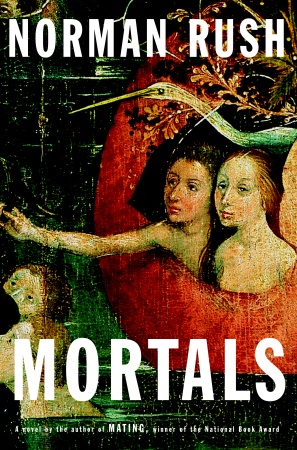
Mortals by Norman Rush. Knopf. 713 pages.
As novelists go, Norman Rush came to writing - or at least publishing - rather late in life, which may be why he's never seemed like an amateur. His 1986 debut, the story collection Whites, published when he was well past 50, revealed a late bloomer who was not only practiced at his craft, but who had logged a lot of time in the real world - like serving as Peace Corps Director in Botswana for six years, among many other jobs - and had read widely. The stories, set among the white transplants and natives of apartheid-era Botswana, were works of chiseled subtlety that crackled with tension, wit and what T.S. Eliot called "felt life." The voices ranged from high to low, and each sounded utterly genuine; here was a country where a withering population uses any means to survive, the ruling class has every reason to be scared, and everyone feels trapped: by the heat, culture, politics. People at a disadvantage from dealing with each other wind up dealing with themselves, facing demons they'd rather not -- like Carl, the American bureaucrat who decides that his hatred of his neighbor's barking dogs is symptomatic of his hatred of life in Africa. Rush immediately brought to mind masters like Forster and Conrad, for whom nothing quite so bares the Western soul as a terminal visit elsewhere. Like the great Bosch painting which has illustrated all the book covers of what now amounts to a loose trilogy, Rush's Botswana is a garden of earthly delights and the lushest hell on earth.
Good as it was, Whites was no preparation for what came next. Mating, Rush's first novel, was a ferociously intelligent love story and an extraordinary literary performance. Where Whites was sparing and contained, Mating was an explosion of verbal fireworks that dazzled from the first page to the last. The narrator is an unnamed anthropology student who recounts in random and meticulous detail her intellectual and romantic conquest of her academic hero, Nelson Denoon, a quirky theorist who establishes the female utopia of Tsau in the Kalahari Desert. Her goal is to absorb every speck of information she can; to not only be as close to Denoon as she can get, "inside the moat," as she puts it, but to be him, to soak his genius into herself. Her favorite word for their relationship is bolus, or "rounded mass," and that's what the book is; it swells from inward to out. Just as Tsau is a "guest organism superimposed on a large organism, the desert," so is she on Denoon; she wants to be remade by him and to remake him, to master all the kinks of his character that he can't master himself. It's a great, strange, exhilarating modern romance, and the voice that glides through it is brainy, vulnerable, and like none I've ever heard.
If Mating was about what joins, Rush's new novel, Mortals, is about what tears apart; and this time, love – and a lot of other things – are scrutinized from the perspective of a declining male rather than an ascending woman. Plotwise, it's very exciting stuff, combining theology, international politics, espionage, gunplay and a familiar story about two men who love the same woman. It's Casablanca as it might be scripted by Dostoevsky, and it is a wobbly construction: engaging and volatile, but also overwrought and talky, with a literariness that becomes somewhat self-conscious.
Ray Finch -- a teacher, would-be writer and CIA operative -- lives in the Botswana capital of Gaborone, where the main satellites of his life are his wife Iris, the poet John Milton and occasional surveillance work. Iris is the queen of Ray's existence: devoted, sexually generous, compassionate, and still a peach at 38. She is also the emotional crutch of both of the couple's siblings back in the States: Ray's estranged brother, Rex, who is dying of AIDS, and Ellen, her own unmarried and pregnant sister. Rex writes her long and intimately detailed letters, partly as a way of connecting with the brother who has rejected him.
For someone who spends so much of his time in spy work, Ray's day-to-day preoccupations are largely literary. His great subject is Milton, whom he hopes to rescue from the political agendas of academics. For Ray, the author of Paradise Lost is a dual character, both rebellious and obedient, an individual genius who threw himself into supporting Cromwell and then became an apologist for Charles II. Ray, who joined the CIA in hopes of stemming the tide of Communism and whose literary ambitions have been put to their service, considers himself an "agent of Milton." He knows all about serving two masters.
Ray claims at the start to have "no great antagonist," but that's about to change. The worm in his apple is Davis Morel, a newly-arrived American doctor of holistic medicine and a pronounced enemy of Christianity. Morel has authored a series of atheist publications which he intends to distribute in hopes of uprooting religion, which he sees as a growing blight on the country. Ray wants to crush Morel, but the Agency isn't interested; instead, they put Ray on the trail of Samuel Kerekang, a peaceful local reformer who is thought to have Communist ties. Ray can't let the Morel matter go, and domestic life soon gives him fresh reasons not to: Iris has started seeing the doctor, and Ray suspects for more than just medical reasons. Morel drives a wedge between Ray and Iris; just as she has been the conduit for Rex's messages to Ray, she now starts enthusiastically regurgitating Morel's doctrinaire atheism. Morel is Ray's "hellmouth" -- the "opening up of the mouth of hell right in front of you, without warning, through no fault of your own."
Hell soon opens up in another way. The Agency's paranoid fear of a Kerekang-led Communist revolt puts Ray on a cross-country fact-finding mission with no goal other than to "find out what was behind everything." Ray is a "projectile aimed at nothing," and his trip becomes a protracted dark night of the soul. Fearing the worst about Iris, and with eternal recurrence snapping at his heels -- "the notion that we, man, were advancing through something that was already over, in some way, like a marriage" – he decides to commit suicide by proxy. Deliberately tempting fate, he burns his passport, destroying his safe identity and, eventually, putting him at the mercy of a CIA-backed Boer death squad, who torture him for information he doesn't have.
Literature is for Ray what William Faulkner said it is for mankind: "one of the props, the pillars, to help him endure and prevail." It's his guide to life, a bearer of wisdom and information. When he notices that Iris has packed Madame Bovary in his suitcase, he fears she may be telling him she is as bored with her marriage as Flaubert's heroine was with hers. Iris has also urged Ray to take along a sprawling, largely incomprehensible literary work by Rex titled Strange News, which he scrutinizes for coded messages from a brother who may well be dead. Ray's torturers think Rex's ramblings are a code, too, and they pummel Ray for answers. He responds by reciting poetry. Literature is the last thing Ray clings to; it's his bulwark against encroaching doom, and Rex's manuscript will be literally that -- it will become his way of escape, as will Morel, who is sent by Iris to save him. As guerrilla warfare breaks out around them, the two men thrash out their problems in a makeshift cell and work on the joint goal of surviving.
Ray, who was perfectly willing to throw his own life away, wonders if any of his own props are worth keeping. There's literature, "the signs and scratchings of the uninteresting entity mankind," there's Iris, who may be sleeping with another man, and there is God, whom he believed in mostly because Milton did and now clings to partly because Morel doesn't. He can reject these things or believe them.
Mortals isn't a book that favors religion, mind you -- if anything, it's more or less supports Morel's belief that Christianity has increased more suffering than it has relieves -- but it has a strange existential belief in the act of believing.
Powerful stuff; unfortunately, the book is less successful as a thing of beauty. Rush works strenuously to deliver what Humphrey Bogart would call a "wow finish"; in an effort to avoid any predictable route, he gets grindingly long-winded, and the sometimes absurd plot twists look like acts of desperation -- you get the sense of an author pumping his story full of air. Ray's showdown with his captors is so labored and chatty that it blunts whatever excitement the book has whipped up, and the weighty romantic encounter toward the end is overblown and swoony. Rush is always at his best when his characters are introspective and reflective, when they can ponder at length all the multiple ramifications of something that's already happened. When the story is in the moment Rush tends to dig his way out with bad dialogue.
Mortals bites off more than it can chew and may have more ideas than it knows what to do with, but it may have greatness within its clumsy grasp. Rush, at 69, is pursuing one of the most ambitious careers in modern fiction.
Wednesday, July 16, 2003

My Big Fat Big Brother Addiction
It's that time of the year again -- and once again, I'm hooked. I know, I know; "Big Brother" is the dumbest show in America and people who watch Reality TV are no better than the saps who participate in it -- it reduces us all to the level of exhibitionists and voyeurs, it pushes the land of the free that much closer to the mouth of hell. I agree completely -- but you're talking to the wrong person. This is, I shamefully admit, my favorite show, and the one program in the world I would not dream of missing. I can channel-surf and bypass my favorite writer on "Charlie Rose." I can hear someone I know personally on the radio and say "Maybe another time" as I click off. I can hear my very name whispered in passing by a stranger and maybe -- just maybe -- not care. But when "Big Brother" comes on, I'm there, usually with a pizza.
How bad is this addiction? Well, this is the fourth season and I didn't miss a single show of the previous three. I remember most of the names of everyone who participated -- total non-entities and thoroughly undeserving wannabe celebrities whose unfunny jokes, personal quirks, nasty habits, unseemly revelations and painfully watchable meltdowns are permanently inscribed in my memory. I remember Karen (Season One) going apeshit over how much she hates her husband. I remember Nicole (Season Two) feeling up Will in the hot tub with her feet. I remember Chiara kissing Lisa (Season Three). I hope to remember this year's Michelle doing something that will haunt her the rest of her days.
There is nothing defensible about any of this, so I may as well stop apologizing -- stop whining and just, you know, work through my addiction, get to the root of the problem, try to figure not only why total idiots fascinate me, but why -- why, Good Lord, why -- I actually kind of dream of joining this cruel form of entertainment, forming alliances, revealing things that will come back to hurt me, and wrecking my life in, oh, so many, many ways. The money, I am sad to report, wouldn't be the spur. I think there's just a complete total fucking self-destructive moron deep inside my soul that is fighting to come out, that needs, nay, even deserves to have his day in court.
Until that day, I will trust these twelve others -- well, eleven now, as Scott (Season Four) abruptly split last night -- to do the work for me. I'm putting three hours a week in your hands, guys. Don't let me down. Go out there and hurt each other.
Thursday, July 03, 2003
Addenda to Berger's Best Friends: I didn't mention it in my review -- because you can clot a small review with only so many references -- that Berger's novel also reminded me of Blake's "A Poison Tree," a poem that has always much impressed me: it reflects the way resentment or bitterness can eventually assume a shape, a deceptive though no less lethal shape.
A Poison Tree
William Blake
I was angry with my friend:
I told my wrath, my wrath did end.
I was angry with my foe;
I told it not, my wrath did grow.
And I water'd it in fears,
Night & morning with my tears;
And I sunned it with my smiles
And with soft deceitful wiles.
And it grew both day and night,
Till it bore an apple bright;
And my foe beheld it shine,
And he knew that it was mine,
And into my garden stole
When the night had veil'd the pole:
In the morning glad I see
My foe outstretch'd beneath the tree.
A Poison Tree
William Blake
I was angry with my friend:
I told my wrath, my wrath did end.
I was angry with my foe;
I told it not, my wrath did grow.
And I water'd it in fears,
Night & morning with my tears;
And I sunned it with my smiles
And with soft deceitful wiles.
And it grew both day and night,
Till it bore an apple bright;
And my foe beheld it shine,
And he knew that it was mine,
And into my garden stole
When the night had veil'd the pole:
In the morning glad I see
My foe outstretch'd beneath the tree.
I don't know -- maybe it's just me: with every new book, I feel I'm getting dumber than I was even a few years ago. Around 1999 or so I read Elective Affinities, and as is so often the case didn't really feel I'd understood it, so I read it again. Recently the Berger book made me think of it so I started it again, mostly to see if my memory was true or false. I've been mostly just stumbling through it; it seems like it should be easier by now, but it's such a strange book -- it's a craggy kind of book. Goethe chews on ideas so much they seem to get stuck in his teeth; either that or I'm just missing the depth of what he's saying half the time, and what's scary is that he might not be saying anything all that terribly complex. That dread "second reading" feeling (actually that would be a fourth reading) is nigh upon me; like I should now attack it yet again, spear in hand, driving my poky white steed through its slim pages. Nah -- I'll resist the urge. I'm all outfitted with the Norman Rush books. I'll move on to them.
Subscribe to:
Posts (Atom)